By: Noor Baloch
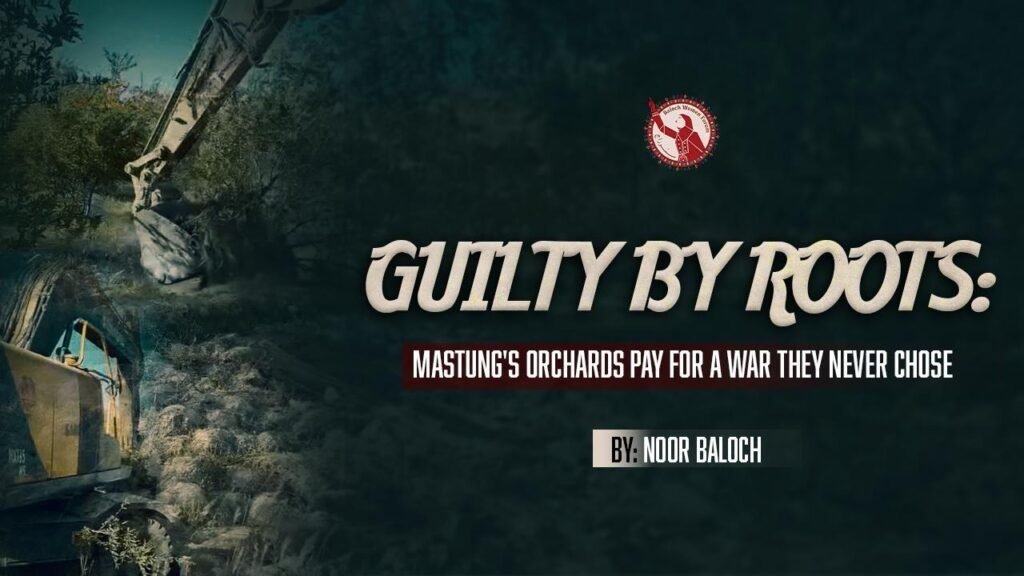
Thirty years. That is how long it takes a grape orchard in Mastung to grow into something a family can live on. Thirty years of watering, waiting, surviving droughts, passing the land from father to son. And now it is being destroyed in a matter of days, not by nature, but by the same state that is supposed to protect it.
The Chief Minister of Balochistan has announced it plainly: if security forces find that any land or orchard is being used by separatists, the owner of that land will be punished. Not the separatists alone. The landowner too. The orchard owner too. As if the family that has spent decades growing grapes on that soil had any say in who walked onto it at night. As if a farmer can stop an armed man from taking cover behind his own trees. This is not policy, this is punishing a man for a crime committed against him.
Think about what is actually being asked here. Separatists do not knock on doors and ask permission to hide. They do not sign an agreement with the landowner before slipping into an orchard for the night. A farmer wakes up in the morning, tends his crop, and has no idea, and no way of knowing, whether his land was used for something the night before. And yet it is that same farmer who will be treated as a facilitator. It is that same farmer whose orchard will be burned, whose water will be cut, whose thirty years of labor will be erased, because he could not stop something he never even witnessed. That is not justice. That is not security. That is the state punishing the powerless for the actions of people who never asked their permission in the first place.
Trees are cut. Crops are flattened. Water to the orchards is shut off under curfew until the vines dry up on their own. Homes are damaged. Whole valleys like Khadkocha, with tens of thousands of people, are being pushed off land that fed them for generations, all because someone, somewhere, decided that guilt by proximity is good enough.
This is not security. This is punishment. You do not fight an insurgency by starving fifty thousand people of their harvest. You do not “clear” a threat by burning down an old man’s orchard because someone, somewhere, might have hidden behind it once, without his knowledge and against his will. This is the state doing the easy thing and calling it the necessary thing. That is not strategy, that is failure dressed up as force.
And who is paying for this failure? Not the fighters. Fighters move. They vanish into the mountains and come back another day. It is the farmer who cannot move. It is the landlord who has nowhere else to plant thirty more years of vines. It is the family whose entire income was standing in a field last week and is gone now, condemned not for what they did, but for what was done to them. Snatch a person’s bread and butter, and you have not just made them poor, you have told them their life does not matter to you. That is what collective punishment always is: cruelty aimed at the people least able to fight back, dressed up as policy.
Nobody in power is saying a word. No real answer for the people of Mastung, no accountability, no apology, just silence from Islamabad and Quetta while an entire province burns and dries up field by field. That silence is its own kind of violence. It tells Balochistan exactly how much its people’s lives are worth to the people who rule over them.
And it is not only people who are losing here, it is the land itself. These are not weeds being cleared. Old orchards hold soil together in a province already choking on drought and heat. They give shade, feed the water table, keep a fragile desert ecosystem breathing. Balochistan is already one of the driest, most climate stressed regions in the country. Tearing out decades old trees and drying out irrigation systems does not just kill this year’s harvest, it wounds the land for a generation, maybe longer. The soil cannot speak for itself. It has no press conference, no protest, no one standing up for it in Quetta or Islamabad. It just dies, quietly, while officials call it “clearing cover.”
The people of Balochistan are being told, again, that their land is not really theirs, that it can be taken, burned, or starved of water the moment the state decides it is inconvenient, and that they themselves can be punished for crimes committed against their own soil without their knowledge or consent. That is not counter-terrorism. That is a people being made to disappear one orchard, one field, one tree at a time, blamed for a war they did not choose and cannot control. And the world needs to be watching, because right now, almost no one is.