By: Noor Baloch
Brutality isn’t just in bullets. It is in the empty plate, the shattered school, the clinic that never opens. It is in the slow erosion of a life where survival becomes the only dream, and identity becomes the only sin.
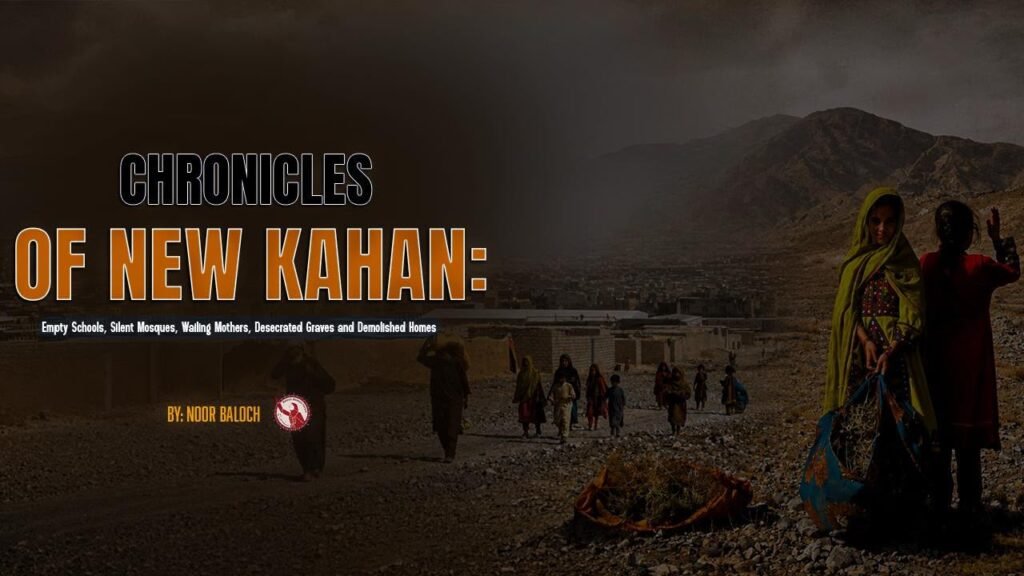
When I first stepped into New Kahan, the very air felt heavy, as if the land itself carried centuries of unspoken grief. New Kahan is just 20 kilometers away from the commercial heart of Balochistan, yet it feels a thousand kilometers away from basic facilities — electricity, gas, proper roads. The gap, though invisible on a map, becomes painfully clear when you step into the village. Here, deprivation is not abstract; it is lived, inhaled, and carried in every step, every breath, every gesture of its people.
This is the stronghold of the Marri tribe, a place shaped by loyalty, struggle, and survival. At the foot of the mountains lies the Tomb of Nawab Khair Bukhsh Marri, not only the revered chieftain of the Marri tribe but also the very conscience of Baloch nationalism and resistance. His presence makes this land both sacred and feared, a constant reminder that even in silence, the spirit of resistance watches over these people.
My first introduction to the people of New Kahan was through the children. Barely four, perhaps seven or eight, they moved about with surprising cheer, gathering dry bushes in their torn dopattas for the evening fire. Tiny, dry, chapped hands collected fuel so their mothers could prepare a simple meal. Their faces were dusty, their hair matted, but what weighed more heavily upon them was not the dust; it was the burden of a destiny denied long before they had learned to dream.
A few steps ahead, two elderly men approached carrying bananas and vegetables. They paused when they saw us, and something flickered in their eyes, hope, fragile and trembling. They thought we were an NGO, someone who might finally listen. Before we could speak, they rushed to us, pouring out their hardships with the urgency of those who have been waiting too long to be heard. Their desperation revealed the truth: no one visits these people (people like us in plain clothes, without uniform). They live like a forgotten chapter, waiting for a messiah who never comes.
Then I noticed another man approaching. His face was pale, his beard and hair greyed by grief more than age. His left hand hung lifeless, his right hand carrying the weight for both. He walked like someone bearing the ghost of his own existence. He insisted I see his demolished home, believing I might tell the authorities, that someone might send funds. He didn’t know I was just as helpless, except my helplessness didn’t show in my clothes or face. His did.
I followed him to his house. The ruin did not shock me; I am accustomed to the conditions of my people. But a sharp pain throbbed in my chest nonetheless. Women in torn clothes greeted us shyly. When I asked how they managed their lives, their answers tangled into confusion. Even they did not fully know how they survived. Chickens, goats, a little milk, a few eggs, a day’s wage if someone got lucky. Some men found work at the truck stand on the highway. The younger boys risked death smuggling petrol across the border, gambling their lives for a few hundred rupees.
Even when they saw me dressed like them, speaking their language, they remained afraid. Their fear wasn’t of me. It was the learned fear of people who live under a shadow so vast that even kin-like faces cannot be trusted.
A school building caught my eye. I walked toward it, stones cutting into my heels, a small pain compared to the ache of seeing a land stripped of its humanity. The school’s exterior looked strong, but inside it was hollow. Dust instead of children. Silence instead of learning. A structure without purpose. A promise without fulfillment.
When I stepped out of the school, my eyes landed on a mosque standing at a distance, abandoned, wounded. Its windows were shattered, and in the corners lay cherpoys, the simple wooden beds used to carry the dead to their graves. I had never stepped into a mosque before; such spaces belong to men. But there were no men here. None inside. None outside. Even God’s house seemed deserted. The air was thick with absence, and the silence spoke of death, not life. It felt as though the right to pray, to live, had been quietly stripped away, another freedom taken from the people of this land.
As I stood absorbing the hollow silence, a piercing wail cut through the air. A woman was crying somewhere outside. I stepped out and saw her in the distance, bent over a grave, her sorrow rising like smoke. I walked toward her, but before reaching her, I stumbled upon a heartbreaking sight, hundreds of headposts scattered across the ground. The symbolic graves of Baloch martyrs, once standing with carved names, now uprooted and thrown aside by the authorities. They fear the dead as much as the living. They believe if they erase the graves, they will erase the memory.
But such acts do not kill memory, they harden it. Every desecrated grave is a wound that refuses to heal. I walked past the fallen headposts and reached the woman whose grief had pulled me from the silence of the mosque. Her face was tired, carved by years of sorrow. She clutched the earth as if holding on to the last piece of her heart.
When I asked gently who she was mourning, she told me through her tears that she sat by the grave of her only son, killed by the state authorities. She cried not just for him but for the life she had lost with him, for the world that had turned its back on her, for the land where even the dead are not allowed to rest.
One could wonder why these people do not come out and protest for their rights, when their men are missing, their basic needs unmet, their homes crumbling, their children growing up in dust instead of dignity. But the truth is harsher than any assumption. They are denied even the right to protest. Fear is not just imposed here, it is internalized, stitched into their memories, their gestures, their silences.
They have been conditioned so deeply that the very thought of raising their voice feels like stepping into a grave. Even if someone were to offer to protest on their behalf, they would still shrink back in terror. One might wonder, what life are they clinging to? A life so stripped of comfort that even suffering seems constant. But it is not the fragile life they fear losing.
They fear the process of life being taken from them.
The slow poisoning of dignity.
The terror of dungeon cells.
The unseen tortures.
The humiliation that crushes a person long before death touches them.
Here, people do not fear dying, they fear the cruelty that precedes death. And so they remain silent, not by choice, but by the brutal conditioning of a system that punishes breath before it punishes rebellion.
New Kahan is not just a village, it is every corner of Balochistan. Its silence, its fear, its scars are repeated across mountains, deserts, and towns, wherever oppression has seeped into the lives of the people. Every place has its own tombs, its own graves, its own stories of those who vanished, leaving behind only the weight of absence.
And in that moment, standing between a desecrated mosque, a scattered cemetery, and the silent watch of a tomb that embodies the soul of a people:
This land is not silent. It is silenced. And yet, its pain speaks louder than any voice ever could. Every step in New Kahan carried glimpses of death, not life. I was in the place of the living dead.