By: Noor Baloch
A few meters away from the Balochistan High Court in Quetta stands a camp bearing a cruel
irony in its name, the “Missing Persons Camp.” It is physically close to the courts of justice, yet
infinitely distant from justice itself. Situated beside the Quetta Press Club, in the very heart of the
provincial capital, the camp remains largely invisible, ignored by mainstream media, overlooked
by the public, and abandoned by the state.
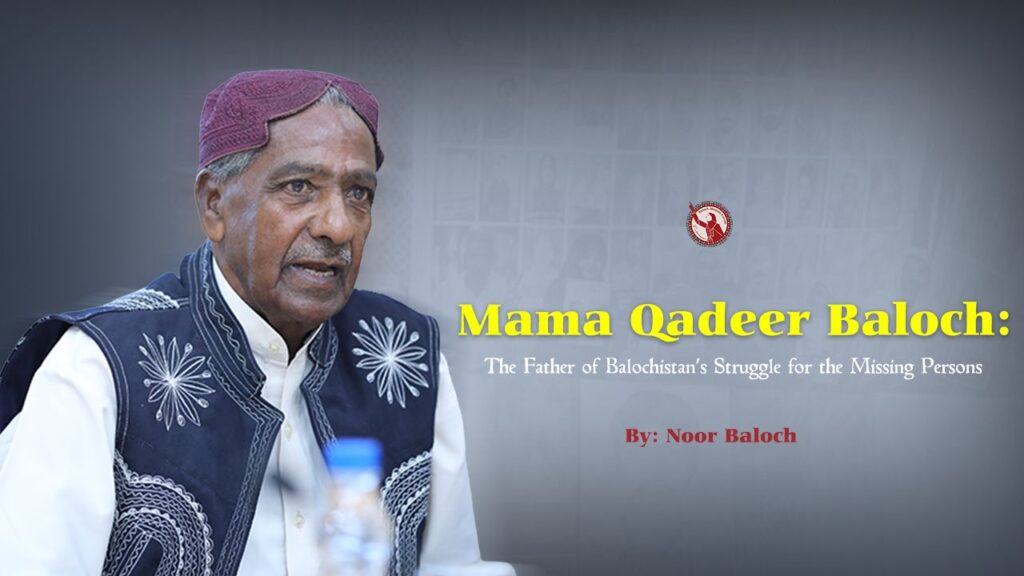
This camp was established by Abdul Qadeer Baloch, affectionately and respectfully known as
Mama Qadeer, a man who transformed personal grief into collective resistance and became the
living symbol of the struggle against enforced disappearances in Balochistan.
Mama Qadeer hailed from Surab district of Balochistan. In February 2009, his life was shattered
when his son Jalil Reki was abducted from Quetta by Pakistan’s state agencies. Three months
later, instead of surrendering to despair, Mama Qadeer erected a protest camp, not only for his
own son, but for every missing son of Balochistan.
Mother’s love is often described as the epitome of devotion, but Mama Qadeer redefined the
depth of a father’s love. He was threatened repeatedly, if he did not end his protest, he would
receive his son’s dead body. He was not intimidated. He did not retreat. He chose resistance over
silence.
Three years after Jalil’s abduction, in 2012, Mama Qadeer received what he had been warned
about, the bullet riddled body of his son, dumped near the Pakistan Iran border in the Sarawan
region, far from where he was abducted. Jalil left behind a 2.5 year old son, born with a hole in
his heart. Doctors advised the family not to tell the child about his father’s disappearance, fearing
it would worsen his condition.
Yet Mama Qadeer made a painful, deliberate choice.
In later interviews, he recalled that when his grandson was five and a half years old, he took the
child by the hand, pulled him toward his father’s lifeless body, and said, “This is your father. He
was killed by unknown men.”
At 72 years of age, Mama Qadeer knew time was not on his side. He wanted to pass on the
legacy of struggle, not through words, but through lived pain. He believed that only someone
who truly understands loss can stand with the oppressed. This moment was not cruelty, it was a
conscious act of political inheritance.
Mama Qadeer’s personal tragedy ignited a movement. His protest camp evolved into a formal
organization, VBMP, Voice for Baloch Missing Persons. For the first time, families of the
disappeared had a platform, a collective voice, and a record. One of VBMP’s most significant
contributions was systematically documenting cases of enforced disappearances, something the
state had deliberately failed to do.
Mama Qadeer’s struggle was not confined to a tent.
In an extraordinary act of resistance, he walked over 2,000 kilometers on foot, from Quetta to
Karachi, and then from Karachi to Islamabad, accompanied by women, elderly parents, and
children of the disappeared. Their feet blistered, their bodies collapsed, but their resolve
remained unbroken.
The blisters on Mama Qadeer’s feet forced him to rest for a few days. The wounds in his heart
never healed, for sixteen years, until his grave.
When he finally reached Islamabad, he sought dialogue. He requested a meeting with the then
Prime Minister Nawaz Sharif. Instead of engagement, Mama Qadeer and his companions were
forcibly ‘deported’ from the capital, silenced, humiliated, and discarded.
Mama Qadeer’s struggle spanned over 6,000 days. These numbers are easy to write, but
impossible to live. As Sammi Deen Baloch, who marched alongside Mama Qadeer for her
missing father Dr. Deen Mohammad Baloch, once said during a protest, “I dare you to live our
life for one day.”
Enforced disappearances are a subject so terrifying that few dare to speak about it. When Sabeen
Mahmud, a Karachi based human rights activist, invited Mama Qadeer to speak about
Balochistan’s missing persons, she was murdered days later by ‘unknown men’. Her killing was
not an isolated act, it was a warning, do not listen, do not speak, do not write.
Yet even such terror failed to silence Mama Qadeer.
It was because of his relentless struggle that international organizations such as HRCP and
Amnesty International were compelled to take notice of enforced disappearances in Balochistan.
Still, within Pakistan, the issue remains unresolved, deliberately unheard, systematically ignored.
Mama Qadeer knocked on every door imaginable, courts, parliament, media houses, and
international forums, asking for nothing extraordinary. His demand was constitutional and
humane. Produce the missing persons before the courts, or at least inform their families whether
they are alive or dead.
That demand remains unmet.
Mama Qadeer Baloch has now left this world. His struggle has not ended. His legacy lives on, in
protest camps, in marches, in records, in grieving families, and in a generation that refuses to
forget.
History will remember him not merely as a father searching for his son, but as the father of
Balochistan’s resistance against enforced disappearances