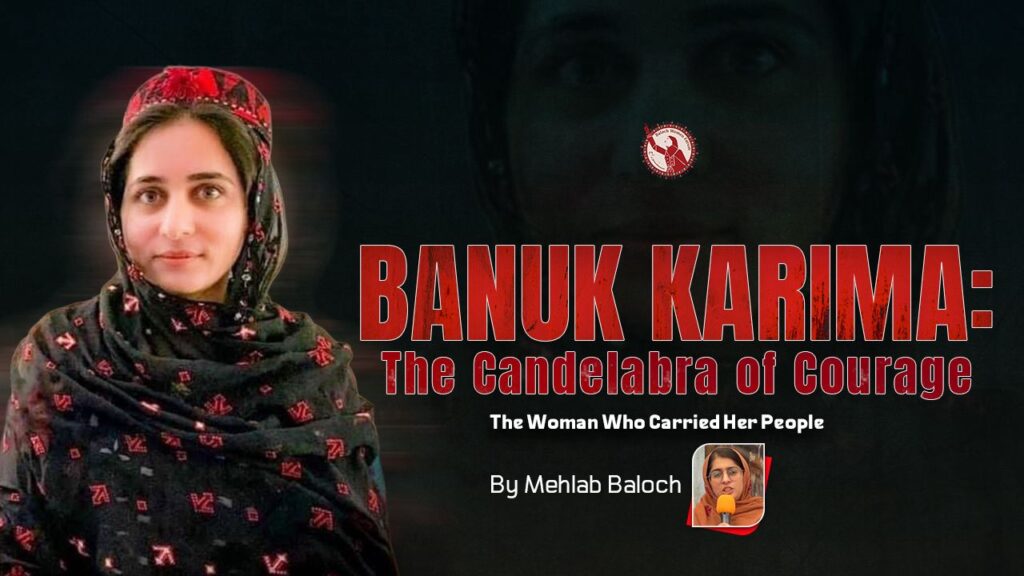
The Woman Who Carried Her People
By Mehlab Baloch
It was one of those bitterly cold winter nights in Lahore, when the smog hung so thick that even the streetlights seemed lost inside it. The night of 22 December, 2020, felt darker than usual, as if it carried a warning. Suddenly, my sister rushed into the room, breathless, her voice trembling as she said, “Did you check social media? Have you heard about Banuk?”
I froze. Her words made no sense. Banuk? How could anything happen to her? But the moment I opened social media, the truth hit me like a storm. Every timeline was flooded with the devastating news of Banuk Karima’s murder. I cried in a way I had never cried before. It felt unreal, painful, and impossible. Losing someone so dear was already unbearable, but losing a political leader whose entire life was a lesson, a symbol, a torch, made the grief indescribable.
Banuk Karima’s political journey had begun at a time when hundreds of Baloch women were waiting for someone to guide them through the darkness of fear, silence, and oppression. When mothers, daughters, and sisters mourned their disappeared loved ones and yet had no path to resistance, she became that path. She emerged at a time when women were frightened to even step outside their homes, when raising a voice against atrocities felt like inviting danger, and when society expected women to remain silent and invisible. The region was suffocated under social media blackouts, information was choked, and there was no one to guide women through the darkness of repression until Banuk Karima became their hope.
I remember how she led marches of hundreds of women in areas of Balochistan such as Dasht, Gomazi, Mand, Tump, Turbat, Shaal, and even Karachi. Her voice rose fearlessly against state brutality and the ongoing Baloch genocide. In an era when silence was imposed and fear was the rule, she dared to break both. She stood firm during a time when Balochistan’s internet was blackout and the world had no glimpse of the suffering of the indigenous people. Yet she fought tirelessly to break through that silence, struggling with every breath to make the world hear and recognize the pain of her people. Through her courage, countless women learned that their voices were powerful, that their presence mattered, and that resistance, no matter how dangerous, was not only possible but necessary.
Her political journey inspired thousands, and her courage earned international recognition. The state feared not just her existence, but the legacy she left behind and the people she empowered to rise. When her dead body was being brought back to Balochistan for burial in the graveyard of Tump, the authorities shut down all networks across the region. Security was so strict that even her own people were not allowed to give her a final farewell. People from every corner of Balochistan were stopped from entering Tump, which showed how deeply the state feared even her lifeless body.
The day after her burial, I went to her grave. Even there, I found forces stationed, scrutinizing every person who came to pay respect. When I took a picture at her grave, a security personnel immediately approached me and ordered me to delete it. In that moment, I realized how much fear a single grave could create in the hearts of those in power. Yet despite their fear, what Karima stood for lives on. She came into this world as one person, but today we see Karima in every child of Balochistan. Her ideology did not end; it lives within her people. As long as a single Baloch is alive, Karima lives in them.
On that cold December night, the world lost not just a brave soul, but a leader who taught courage to countless people and proved that even in the darkest times, resistance is possible.
On the occasion of Banuk’s 5th martyrdom anniversary, I do not only pay rich homage to the brave leader, but also ask the Baloch to study her and adopt her ideas to bring positive societal changes.