

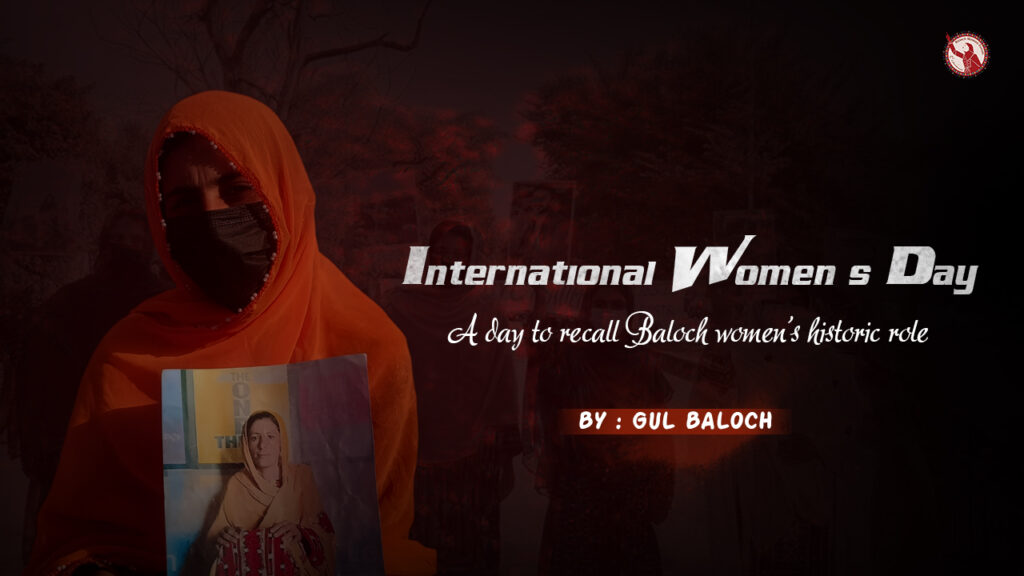
By: Gul Baloch
8th of March, since 1975, is globally recognized as International Women’s Day. This day is celebrated for all the women around the world. It is observed for two very purposes: one, to dedicate it to those women who changed the world, even in small ways, and who have shown courage and strength. Two, to endorse the ongoing struggles women are making across the corners of the world. The women, as a whole, have been warriors, mothers, fighters, and the true nurturers of this world. In a world where they are rarely given the desired status and position, women have come a long way to get themselves widely endorsed as change-makers – for whom, mere words would never be enough to describe their contributions. From their role to life-givers to enduring pains of their loved ones to their outnumbering contributions in the social and national lives, women are worth a day to celebrate, and a life to endorse.
History of International Women’s Day:
The world has come a long way to honor the women in the practical senses – as early as in the wake of the twentieth century. A massive 15,000-populated protest in 1908 took over the streets of New York City, demanding simple things: less working hours, handsome pay and, above all, voting rights in elections. Following the intensity of the protest, the administration was compelled to give them their amenities.
Looking at the success in America, women in Europe took the lead where over 1 million women, backed by several of their counterparts, took on the roads of Europe in 1911, initially involving few countries including Denmark, Germany, Austria and Switzerland, later Spain and France joined the party and raised similar slogans. Through a collective voice, they received what actually belonged to them.
Considering the level of protests, in 1917, the Russian women, too, took the lead and protested with clearer slogans: “Down with War, Down with Hunger.” In their campaign, their male counterparts, who were part of the factories, left their work and joined their women in their campaign, eventually leading them to success.
With all the recorded protests, women had the leading role. Initially, Americans observed February 28 as their National Women’s Day which was celebrated from 1909 to 1914, while Europe fixed the date on March 19. After the participation of Russian women, the unanimous date fixed for the very day was March 8, which the United Nations Education, Scientific And Cultural Organization (UNESCO) endorsed in 1975. Since then, 8 March is globally celebrated as “International Women’s Day”.
Baloch Women and The ongoing struggle:
We can speak about Baloch women all day and we will still need more to speak. We can recall the sacrifices Baloch women have given in the past to the appreciation of their contemporary struggle and sacrifices they are making for the collective national wellbeing. Marking with the emergence of Banuk Karima Baloch in 2005, contemporary Baloch struggle saw a shift from producing a number of women activists who are presently serving in various political and social movements. Banuk emerged when it was all about men leadership in the Baloch politics and then ruled in the next decade until she was elected as the Chairperson of the organization in 2015 (first ever woman chairperson of a Baloch political entity).
After Lumma Karima, we saw a growing number of women leadership taking the lead, including Dr. Mahrang Baloch, Dr. Sabiha Baloch, Dr. Shalee Baloch, and a list of women leadership in lower stages. Not only have they taken the lead, but are facing direct state brutes at its face, and yet thoroughly committed towards their campaign for the societal welfare.
This International Women’s Day is to Baloch Women Leadership:
Let me dedicate this day to those Baloch women — the Baloch mothers, sisters, and daughters — who have been facing injustice and, instead of choosing silence, are parts of the social and political movements. Many of them have endured humiliation under the law, have suffered torture, and have been thrown into prisons and dark cells. Yet their courage remains unbroken. Their relentless efforts and their determination for dignity and justice have only grown stronger with time.
Let me dedicate this day to those women, especially the Baloch women, who have stood as the strength and support of their brothers and fathers. They have become the seekers of their missing loved ones, searching tirelessly for those who have disappeared. They have not only endured their own pain, but have stood with an entire nation. They have embraced every disappeared person as if they were their own, and have carried the grief of every lifeless body as a shared sorrow. They have accepted the pain of the whole nation and transformed it into strength. These women have been brave fighters against a system that seems blind, deaf, and silent—unable to see, unable to hear, and unwilling to speak. Yet despite this cruelty, they continue their struggle for truth, dignity, and justice.
Let me dedicate this day to the mother of the Baloch nation — to our very own Lumma Karima Baloch, who has been a guiding light and a symbol of resistance against the injustice. Along with Lumma, this day is to those courageous mothers who have nourished their children with national sentiments. I dedicate this day to the mother of Zakir Majeed, Lumma Raj Bibi, and to the mothers of every disappeared person who sits on the roads with photographs in their hands, demanding justice for their children.
This day is to endorse the struggle Dr. Mahrang Baloch, who has become a voice and a leader for many suffering families, standing for justice and dignity. And from the depths of my heart, let me also dedicate this day to Dr. Sabiha, and Dr. Shalee, who have bravely stood against oppression and raised their voices for truth and justice. This day clearly belongs to those who have never given up with their cause.
Conclusion:
International Women’s Day is not only a one-day celebration, but a stark reminder that Baloch have always been a nation of standards and norms, where gender was never an issue, but foreign invasions. They have always stood with the just, and never compromised on national interests – neither will they ever think something beyond national interests. Today, despite the fact that there are direct attempts to portray the Baloch issue as a gender-based dilemma, but it never is neither was it ever.
Happy International Women’s Day to the cherishing Baloch women political leaders and figures of social movements who have helped decoding the colonial-cum-imperial narratives concerning the Baloch struggle.


